
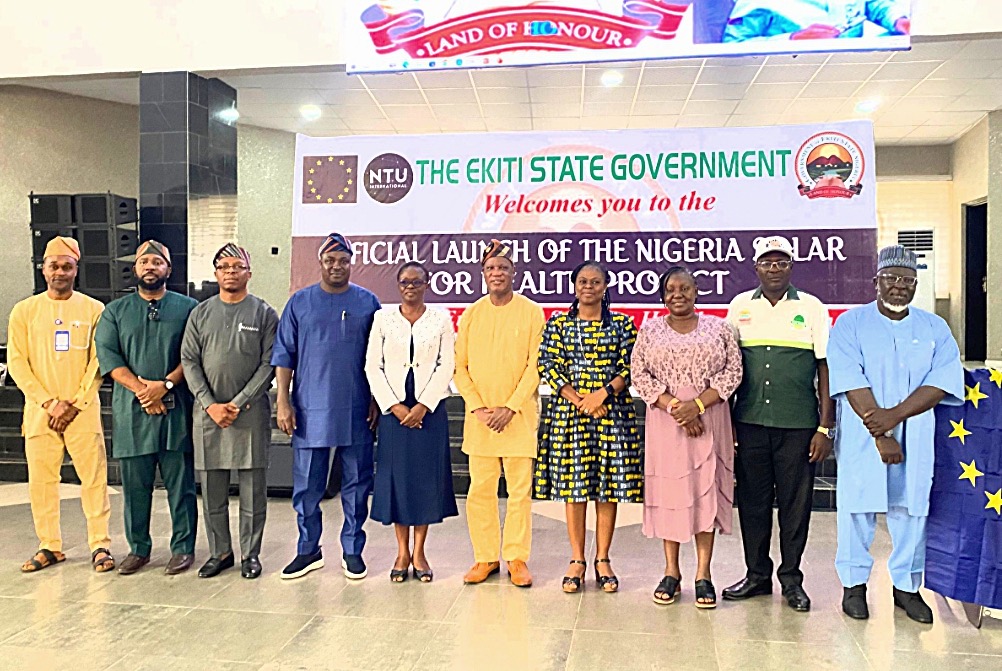
The Ekiti State Government has launched the Nigeria Solar for Health Project (NISHP) to improve electricity supply to primary healthcare centres and surrounding small and medium-scale enterprises (SMEs) through renewable solar energy.
Ekiti is one of seven participating states in the initiative, which is designed to ensure reliable power supply for vaccine storage, safer childbirth deliveries and improved healthcare services, particularly in rural communities, while also supporting nearby SMEs for sustainability.
Speaking at the launch in Ado-Ekiti, Governor Biodun Oyebanji, represented by the Commissioner for Infrastructure and Public Utilities, Prof. Mobolaji Aluko, said the project was part of the administration’s broader efforts to address the state’s electricity challenges through various interventions.
He said the initiative would help eliminate cases of childbirth in darkness and prevent vaccine losses at primary healthcare centres.
Oyebanji described electricity supply from the national grid as inadequate despite substantial state investments, noting that the government had supported distribution companies through the construction of hundreds of kilometres of 33KV and 11KV feeder lines, as well as the installation of hundreds of transformers.
He said several local government areas had been reconnected to electricity after about 15 years of blackout, adding that efforts to extend electricity access and double transmission capacity were ongoing in collaboration with the Transmission Company of Nigeria (TCN).
The governor added that the state’s 2.625-megawatt Compressed Natural Gas-powered plant currently supplies 24-hour electricity to key institutions.
He also highlighted several Rural Electrification Agency-supported and private-sector renewable energy initiatives, including mini-grid and hydropower projects across the state, particularly at major dams, to improve water supply and power access.
The Commissioner for Health and Human Services, Dr Oyebanji Filani,
described the project as critical to strengthening healthcare delivery, noting that poor electricity supply remains a major challenge in the sector.
The Commissioner for Budget, Economic Planning and Performance Management, Mr Femi Ajayi, noted that the project reflects the government’s commitment to citizens’ welfare and called for sustained stakeholder collaboration.
The NISHP Team Lead, Engr. Nasiru Bello, and the European Union representative, Mr Godfrey Ogbemudia, commended Ekiti State’s preparedness for the project, describing it as exemplary.
Senior Stakeholder Engagement Manager, Mr Tinyan Ogiehor, said Ekiti would receive up to 11 installations of 250-kilowatt peak solar systems under a 2.5-megawatt rollout across the seven participating states.
He said the battery systems would be capable of powering facilities for several days without connection to the national grid.
According to him, about 130 health facilities and 415 small businesses are expected to benefit nationwide under a funding model in which telecommunications and other private firms subsidise access, while health centres pay minimal service fees.
As part of the programme, 22 engineers, electricians and health workers were trained in energy auditing and digital data collection.
The training forms part of the partnership between the Ekiti State Government, the European Union and a Danish consortium led by NTU.
A 2024 Nigerian Health Facility Registry report indicates that fewer than 25 per cent of public health facilities in the country are fully operational, with many lacking access to grid electricity.
Officials said Ekiti’s early commitment and swift implementation of the project position the state to significantly improve healthcare delivery through reliable and clean energy solutions.